
Tessellations and angle sums
Use rigid motions and angle sums to test and construct tilings with no gaps or overlaps.
A plane tiling must fit around every vertex and repeat without gaps or overlaps.
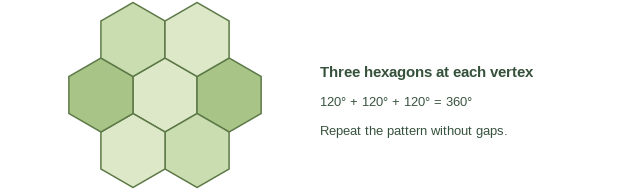
A tessellation covers the plane with copies of one or more shapes. Translations, rotations, and reflections can repeat tiles. In an edge-to-edge tiling, angles meeting at each vertex total 360°. A regular n-gon has interior angle (n−2)180°/n. Equal copies can fit at a vertex only if a whole number of those angles totals 360°. This local check rules out many candidates, but a general tiling also needs compatible edges and a pattern that continues. Equilateral triangles, squares, and regular hexagons each tile the plane on their own; arbitrary hexagons need further checking.
Can regular octagons tile edge-to-edge by themselves? How can squares fill the gaps?
- A regular octagon has interior angle (8−2)180°/8 = 135°.
- 360°/135° = 8/3 is not a whole number, so identical octagons alone cannot fill each edge-to-edge vertex.
- Two octagon angles and one square angle total 135° + 135° + 90° = 360°. With equal edge lengths, alternating octagons and the square gaps produces a repeating tiling.
How many regular hexagons meet at a vertex? Why do regular pentagons fail this same edge-to-edge test?
Check your reasoning
A regular hexagon has angle 120°, so three meet at a vertex. A regular pentagon has angle 108°; three leave 36° and four overlap. No whole number of 108° angles totals 360°.
This self-check is for practice. It does not submit an answer or record mastery.
The angle test is necessary locally. It does not prove that every irregular polygon with a convenient angle can tile the whole plane.
Ideas from CK-12
These original explanations and examples draw on the concepts in CK-12 Geometry Concepts (2012). Read the corresponding book lessons:
- 12.7 · Tessellations · p. 526
Show what you understand
Explain why regular hexagons tile and regular pentagons cannot form an edge-to-edge tiling by themselves; sketch a repeatable tile pattern.
Complete this task on paper. In your student account, you can record lesson completion and use daily practice.
Create your account →