
Self-similarity and repeated scaling
Describe self-similar patterns and calculate how iteration changes piece counts, lengths, perimeters, and areas.
Repeated scaled copies let us track count, length, and area separately.
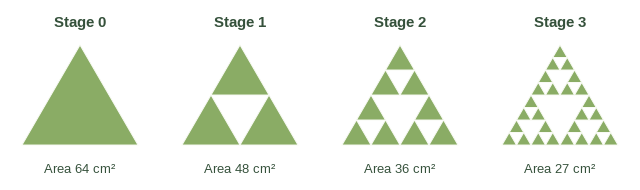
A self-similar figure contains smaller copies with the same shape as the whole. An iteration repeats a construction rule; call the initial figure stage 0. In a Sierpinski-style triangle, join the side midpoints and remove the open central triangle, then repeat in each remaining triangle. Each step keeps three copies with half the previous side length. A finite drawing illustrates the process; the ideal fractal results from continuing indefinitely. Nature can show approximate self-similarity without matching this exact rule.
A growing boundary at a smaller scale
For a Koch-style boundary, replace each line segment with four segments, each one-third as long, making an outward triangular bump in the middle. One iteration therefore multiplies total boundary length by 4/3. This contrasts with the shrinking total area in the triangle-removal example: counting the pieces and tracking their dimension are separate steps.
Example. Start with an equilateral triangle of perimeter 27 cm. After two Koch steps its boundary has 3×4² = 48 segments, each 9/3² = 1 cm long, so its perimeter is 48 cm. Equivalently, 27(4/3)² = 48.
Start with a triangle of area 64 cm². Remove each central quarter repeatedly. What remains after three stages?
- Each stage keeps 3/4 of the previous area because each of three half-size triangles has 1/4 of that area.
- After three stages there are 3³ = 27 small triangles. Each has side scale (1/2)³ = 1/8 and area 64/64 = 1 cm².
- The total remaining area is 64(3/4)³ = 27 cm². Piece count increases even though total area decreases.
A Cantor-style construction removes the middle third of each remaining interval. Starting from length 81 cm, what total length remains after two stages?
Check your reasoning
There are 2² = 4 intervals, each 81/3² = 9 cm long, for 36 cm total. Equivalently, multiply 81 by (2/3)².
This self-check is for practice. It does not submit an answer or record mastery.
A length scale of 1/2 gives an area scale of 1/4 for each copy; include the number of copies before totaling the area.
Ideas from CK-12
These original explanations and examples draw on the concepts in CK-12 Geometry Concepts (2012). Read the corresponding book lessons:
- 7.13 · Self-Similarity · p. 310
Show what you understand
Compare the side scale, piece count, and remaining area after several stages of a self-similar construction.
Complete this task on paper. In your student account, you can record lesson completion and use daily practice.
Create your account →