
Sector area and circle modeling
Calculate sector area and perimeter and find circular-segment area by subtracting the enclosed triangle.
A sector occupies the same fraction of a circle's area as its angle occupies of a full turn.
A sector is bounded by two radii and their intervening arc. Its area is (θ/360°)πr² in degrees or r²θ/2 in radians. A circular segment is bounded by a chord and an arc. For a minor segment with central angle at most 180°, subtract the triangle between the radii from its sector. The sector perimeter uses two radii and the arc; the segment perimeter uses the chord and the arc.
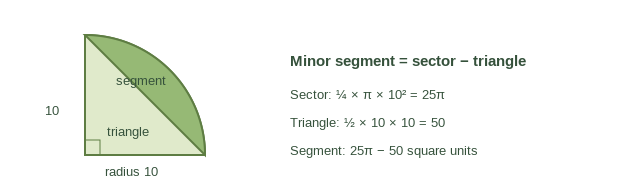
A radius-10 circle has a 90° sector. Find the sector area, the minor segment area, and the sector perimeter.
- The sector is one quarter of the circle, with area 25π square units.
- The two radii form a right triangle with area (1/2)×10×10 = 50. The minor segment area is 25π−50, about 28.54 square units.
- The quarter-circle arc is (1/4)×20π = 5π. Adding two radii gives sector perimeter 20+5π units.
In a radius-8 circle, find the minor segment area cut off by a 60° central angle.
Check your reasoning
The sector has area 64π/6 = 32π/3. The triangle between its radii is equilateral with side 8 and area 16√3. Subtract to obtain 32π/3−16√3 square units.
This self-check is for practice. It does not submit an answer or record mastery.
A sector includes the triangle between its radii; a minor segment excludes it. Keep arc length and area units distinct.
Ideas from CK-12
These original explanations and examples draw on the concepts in CK-12 Geometry Concepts (2012). Read the corresponding book lessons:
- 10.11 · Area of Sectors and Segments · p. 450
Show what you understand
Find an exact sector area and explain why arc length uses linear units.
Complete this task on paper. In your student account, you can record lesson completion and use daily practice.
Create your account →